


Table of Contents
- How to Check Fabric Quality
- How to Identify Quality Stitching
- Signs of Poor Quality Clothing
- Assessing Garment Construction and Finishing
- Modern Quality Markers: Authentication and Certifications
- Evaluating Fit, Drape, and Hand-Feel
- Assessing Second-Hand and Vintage Clothing Quality
- Conclusion
Last Updated: August 17, 2026
How to Check Fabric Quality
The foundation of assessing clothing quality starts with understanding what you're touching. Run your fingers across the fabric itself, the hand-feel tells you almost everything you need to know about whether a garment will last or fall apart after a few washes.
Natural fibers like cotton, linen, wool, and silk have distinct characteristics that synthetic materials can't replicate. When evaluating quality, you're asking: Is this made from materials built to last, or designed to be disposable?
Natural Fibers vs. Synthetic Materials
Quality clothing typically relies on natural fibers or high-quality blends. Pure cotton, especially ring-spun cotton, has a soft, consistent hand-feel and breathes naturally. Linen feels slightly crisp and softens with wear. Wool provides natural temperature regulation and durability that synthetics struggle to match.
Synthetic materials like polyester, acrylic, and nylon are often cost-cutting measures. Polyester doesn't breathe as well, pills more easily, and can feel plasticky. However, synthetics mixed with natural fibers in the right proportions work well, a 95% cotton, 5% spandex blend gives stretch without sacrificing breathability.
Check the fiber composition label. If it lists only synthetics or a majority synthetic blend, you're likely looking at fast-fashion construction. Quality garments typically highlight their natural fiber content prominently.
Fabric Density and Opacity
Hold the garment up to light. If a t-shirt is transparent, the fabric density is too low. Higher density fabrics have tighter weaves that prevent light from passing through and indicate stronger construction.
Feel the weight of the garment. A quality t-shirt should have substantial heft, not feel limp or flimsy. Heavier fabrics (measured in ounces per square yard) generally indicate better durability and longer garment life. Density also affects opacity, a shirt that shows everything underneath is impractical to wear.
Testing for Wash Resistance and Durability
Tightly woven fabrics resist pilling and shrinkage better than loosely constructed ones. Run your fingernail gently across the fabric surface. If fibers snag easily or the fabric pills immediately, it won't hold up to regular wear and washing.
Ask yourself: Does this fabric feel engineered to last, or like it might fall apart? That intuition becomes your best tool for assessing wash resistance.
How to Identify Quality Stitching
After fabric, stitching is the second most important indicator of quality. Poor stitching unravels, seams separate, and the garment falls apart. Good stitching holds everything together through years of wear.
Seam Types and Seam Allowance
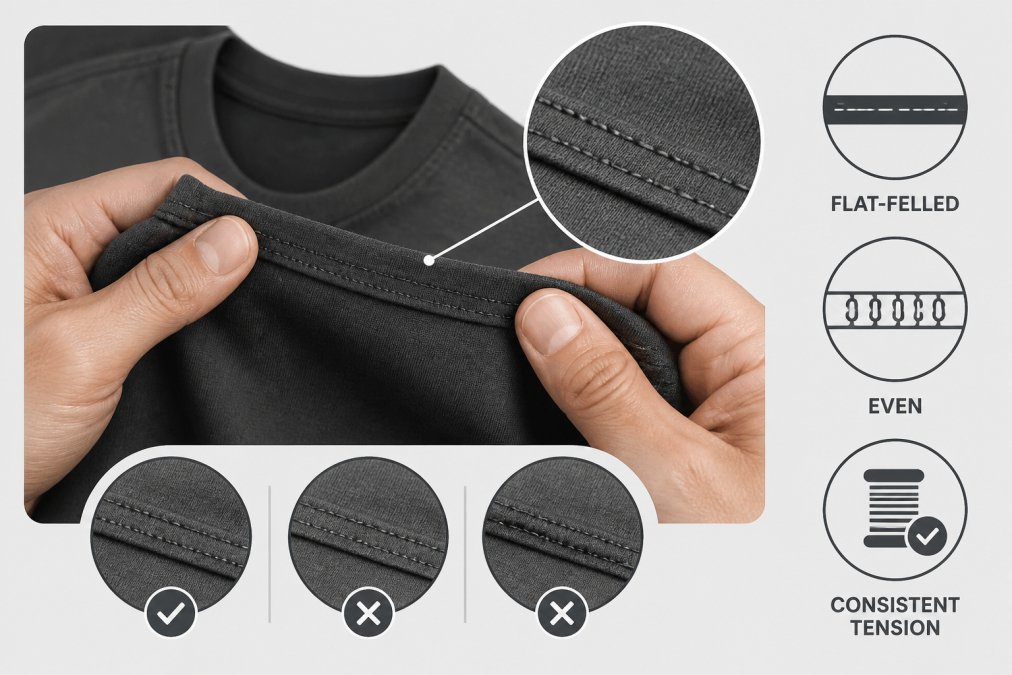
Look at the inside of the garment. Quality construction uses specific seam types designed for durability. Flat-felled seams, where one seam allowance is folded over and stitched down, are stronger than simple single-needle seams. Bound seams, where raw edges are wrapped with binding tape, indicate thoughtful construction and prevent fraying.
Check the seam allowance, the distance between the stitching line and the raw edge. Generous seam allowance (half an inch or more) allows for alterations. Skimpy seam allowance indicates budget construction.
Run your finger along the seams. They should feel smooth and even, not puckered or wavy. Puckered seams indicate poor tension control during manufacturing.
Stitch Count and Thread Tension
Quality garments typically have 12-16 stitches per inch. More stitches create stronger seams; fewer create weaker ones. This matters especially at stress points like armholes and crotch seams.
Thread tension matters as much as stitch count. If too tight, it pulls the fabric and creates puckering. If too loose, seams separate easily. Quality manufacturers dial in thread tension precisely for each fabric type.
Look at the thread itself. Does it match the fabric color and composition? A cotton t-shirt should have cotton thread, not polyester thread that will break down at a different rate.
Signs of Poor Quality Clothing
Knowing what to avoid is just as important as knowing what to seek.
Pilling, Shrinkage, and Raw Edges
Pilling, those little balls of fiber that form on the surface, indicates weak fiber structure. Quality fabrics resist pilling because fibers are tightly bound.
Check if the garment has been pre-shrunk. If it hasn't, you're buying a garment that will fit differently after the first wash. Raw edges inside the garment, where fabric is simply cut and left unfinished, indicate corners were cut. Quality construction finishes edges through binding, serging, or folding and stitching.
Button and Hardware Durability
Examine every button, snap, and zipper. Quality buttons feel substantial and are sewn on with multiple passes of thread, creating a small shank between button and fabric. Cheap buttons are glued or sewn with just one or two passes.
Try to wiggle the buttons, they should be completely secure. Check the thread used to attach them; it should match the fabric or be reinforced with multiple strands.
Zippers should slide smoothly without catching. A zipper that sticks or misaligns indicates quality control issues throughout the garment.
Assessing Garment Construction and Finishing
Beyond fabric and stitching, overall construction quality reveals how much care went into making the garment.
Lining and Internal Details
Quality garments often have linings, especially in structured pieces like blazers and jackets. Check if the lining is sewn securely or just glued on. Sewn linings last much longer.
Examine the inside overall. Are there loose threads hanging around? Quality manufacturers finish every interior detail because they know people will see it. A messy interior suggests quality control is lax throughout production.
Look at hems. Are they straight and even? A crooked hem indicates the garment was rushed. Quality hems are folded precisely and stitched with consistent tension.
Hem Quality and Reinforcement
The hem is where stress concentrates during wear and washing. A weak hem unravels; a strong one lasts the life of the garment. Quality hems are reinforced at stress points, especially where the hem meets the side seam.
Check if the hem is hand-stitched or machine-stitched. Both can be quality; what matters is whether the stitching is even, tight, and reinforced. The width of the hem matters too, wider hems (one inch or more) provide more fabric for alterations. Narrow hems (half inch or less) limit alterations and suggest cost-cutting.
Modern Quality Markers: Authentication and Certifications
Today's quality assessment goes beyond traditional inspection. Digital authentication and certifications provide third-party verification of quality and manufacturing practices.
Digital Authentication and QR Codes
Some quality brands now include QR codes on labels that link to product information, manufacturing details, and authenticity verification. Scanning the code should show you exactly where and how the garment was made. This transparency signals confidence in quality.
Counterfeit garments can't replicate these systems reliably. Quality-focused brands increasingly use digital authentication to help customers verify they're getting genuine products.
Sustainable Manufacturing Certifications
Certifications like GOTS (Global Organic Textile Standard), Fair Trade, or OEKO-TEX indicate the manufacturer meets specific standards for environmental responsibility and worker treatment. These certifications cost money and require third-party audits, so brands that pursue them are serious about quality.
Look for these certifications on the label or product page. They represent actual compliance with external standards.
Evaluating Fit, Drape, and Hand-Feel
How a garment fits and feels on your body is the ultimate test of quality. A well-constructed garment drapes naturally, doesn't bind or pull, and feels comfortable immediately.

Drape refers to how fabric hangs on the body. Quality fabrics with appropriate weight and fiber composition drape smoothly, following body contours without clinging or bunching. Poor-quality fabrics either hang stiffly or cling awkwardly.
Run your hand across the surface. Quality fabrics feel smooth and consistent. Cheap fabrics feel rough or scratchy. Try the garment on if possible. Does it move with you or against you? Quality construction allows natural movement. Seams shouldn't pull or bind.
Assessing Second-Hand and Vintage Clothing Quality
Vintage and second-hand garments can be higher quality than new fast-fashion alternatives, but you need different assessment criteria.
Examine the garment for wear patterns. Authentic vintage shows wear consistent with age and use. Check if the garment has been altered or repaired, quality vintage often shows evidence of professional tailoring, indicating the original owner valued the piece.
Inspect seams and hems closely. Vintage garments that have held together for decades have superior construction. Look at the fiber content. Vintage garments are often made from natural fibers because synthetics weren't as prevalent decades ago.
Smell the garment carefully. A musty smell is normal for vintage and usually washes out. A chemical smell suggests the garment was treated with harsh chemicals. Quality vintage has been stored properly and doesn't retain harsh chemical odors.
| Assessment Factor | What to Look For | Quality Indicator |
|---|---|---|
| Fabric | Natural fibers, appropriate weight, tight weave | Soft hand-feel, opaque, substantial heft |
| Seams | Flat-felled or bound construction, even stitching | 12-16 stitches per inch, no puckering |
| Buttons | Substantial, securely attached with multiple passes | No wiggle, thread reinforced, proper spacing |
| Hems | Even, reinforced, appropriate width | Straight lines, consistent tension, no fraying |
| Interior | Finished edges, clean construction | No loose threads, neat seams, quality lining |
| Certifications | GOTS, Fair Trade, OEKO-TEX | Third-party verification of standards |
Learning how to tell if clothing is high quality protects your investment and builds a wardrobe that actually lasts. The difference between garments that fall apart and those that survive years of wear comes down to fabric choice, stitching precision, and manufacturing attention to detail.
When you're ready to invest in quality pieces that combine durability with personality, Scott's T's & More offers thoughtfully constructed apparel designed to last. For example, check out the Heart Faith Iridescent - It Takes Faith to Lead our Hearts to the Cross - new t-shirt for $17.99, or the long-sleeve version for $26.99. If you're looking for something with a bit more edge, the Old People Don't Play T-Shirt | Cemetery Gravestone Vintage Skull Graphic is available for $18.99. Their focus on quality construction, from fabric selection to finishing details, ensures your wardrobe reflects both your style and your values. Explore their collection of durable, high-quality t-shirts and apparel that won't fade or fall apart after a few washes. Continue shopping.

Frequently Asked Questions
What are the signs of high-quality stitching in garments?
High-quality stitching shows consistent stitch count (typically 12-15 stitches per inch), even tension with no puckering, and reinforced seams at stress points like armholes and crotch seams. Flat-felled or bound seams indicate superior construction. Check that thread color matches the fabric, stitches are straight without gaps, and there are no loose threads. Raw edges suggest lower quality, while finished seams show attention to detail.
How can you tell if fabric will hold up after multiple washes?
Feel the fabric density by pinching it, denser fabrics resist pilling and tearing better than loose weaves. Look at the fiber composition: 100% cotton or cotton-blend fabrics from ring-spun yarn tend to last longer than thin synthetics. Check the fabric weight (heavier usually means more durable), and inspect for loose fibers or a flimsy hand-feel. Quality garments typically list care instructions that recommend gentle washing and air drying, indicating the maker expects longevity.
What's the difference between natural and synthetic fibers in terms of durability?
Natural fibers like cotton and wool offer breathability and comfort but can shrink and pill if not properly constructed. High-quality natural fibers maintain their integrity through many washes. Synthetic materials like polyester resist shrinkage and pilling better but can feel cheap and trap moisture. The best garments blend both: quality cotton blended with a small percentage of polyester (like our Scott's T's & More collection uses 100% USA cotton) provides durability, breathability, and lasting comfort without compromising on hand-feel.
Does a higher price tag always mean better clothing quality?
Not always. Price reflects brand reputation, design, marketing, and production location as much as actual quality. A $30 garment with superior fabric density, flat-felled seams, and natural fiber composition can outperform a $60 trend-driven piece. Focus on tangible quality markers: fiber content, stitch count, seam construction, and hardware durability rather than the brand name. Reputable makers like Scott's T's & More price fairly based on materials and craftsmanship, not hype.
How do I check for garment construction flaws in a store?
Inspect seams for loose threads, puckering, or uneven stitching. Check buttons and zippers for secure attachment and smooth operation. Look at the hem for straight, even stitching with no gaps. Examine the lining (if present) for tears or loose threads. Feel the fabric for thin spots or loose weaves. Turn the garment inside out to inspect reinforcement at stress points. Try it on to assess fit and drape, quality clothing hangs smoothly without bunching or pulling.
What should I look for when buying funny t-shirts to ensure they'll last?
Check the base fabric first: 100% preshrunk cotton or high-quality cotton blends resist fading better than thin synthetics. Examine how the design is applied, screen-printed designs on quality garments hold up through many washes without cracking. Look at the blank shirt construction: reinforced seams, proper hem quality, and sturdy buttons matter just as much for funny tees as any other apparel. Scott's T's & More uses Gildan blanks with 100% USA cotton and proper construction to ensure your humorous designs stay vibrant and wearable for years.
How can I tell if a garment's color will fade or change after washing?
Inspect the dye quality by checking if the fabric smells strongly of chemicals, quality dyes have minimal odor. Look at the garment tag for dye type and care instructions. Rub a damp white cloth on the inside seam to check for color bleeding. Quality garments use colorfast dyes that bond properly to natural fibers. Preshrunk fabrics indicate proper finishing and tend to hold color better. Avoid garments with a harsh chemical smell, which suggests poor dye quality and potential fading.
This article was written using GrandRanker